
EXPLORATIONS IN PINE RESIN
Explorations in Pine Resin is an ongoing investigation into pine resin’s properties and characteristics; aiming to see how a material which was once in widespread use around the world can be given a contemporary revival.
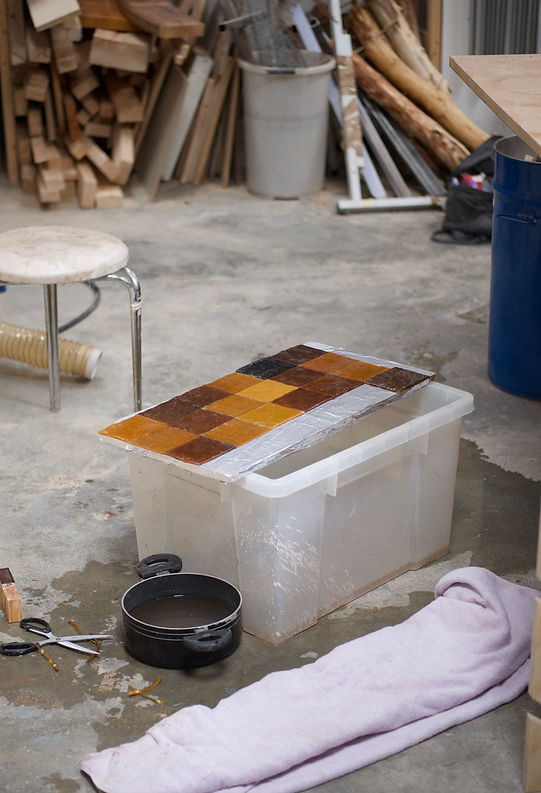
Currently comprising of an eclectic mix of vessels and collaged platters, as well as handles and lamps which utilise resin's warm amber hues, the collection also asks a series of fundamental questions about our material landscape itself. Such as whether there is as much to be learnt from investigating prehistoric materials as from developing new ones, and if resin’s biodegradable and carbon negative properties - being rich in hydrocarbons and capable of harvesting from trees without harm - makes it an ideal material for a renewable, low-carbon future.


Pine resin which is naturally produced by trees to seal damage to their bark, has a deep and far reaching history. For hunter-gathers it was a means of making spears, for colonial naval fleets it ensured ships remained watertight, and today Greek's use the substance to produce their distinctive Retsina wine. However, in all examples, resin plays a secondary role rather than that of the primary material.
This research led me to conduct over 150 different experiments to see how resin's unique properties could lend itself to contemporary objects, with each piece seeking to showcases one or more of its possibilities. Vessels for example highlight it's capacity to waterproof almost any material - even those which are highly porous like paper or card - and handles and lamps illustrate its anti-bacterial and translucent quality.
True to the studio's philosophy, it was vitally important to understand the source of the material, and so in collaboration with Surrey Wildlife Trust I harvested resin from a black pine tree, with the viscous liquid oozing out within seconds of the first incision.
This is a process which has been carried out for hundreds of years, and when done correctly causes no significant harm to the tree and is even said to have some positive impacts on the forest as a whole.



Watch a video of the project here.


Further research was carried out into pine resin during Marks' residency at the EMMA Kreativzentrum.